ÜBERSTUNDE – Afterwork Event Platform
Community & Event Managment Platform for one of Germany's most popular Networking Event organizers

ÜBERSTUNDE is a well-known organiser of after-work events, with a presence in more than 10 cities across Germany. In order to address the requirements of this expanding franchise, a tailored platform has been developed for the management of events and the establishment of a community, both in online and offline spaces.
Role
UX Designer & Engineer
Timespan
June 2025 - today
Context
Agency project @ ventureon
Keywords
Full Stack Development, API Design, UX Design, Stripe Integration
- 4.9 days Earlier ticket purchases Tickets are now bought around 14 days before the event, thanks to the introduction of ticket phases
- 74% Time saved in event management, with automated processes instead of cross-checking guests in Excel
- Self-service Ready for franchisees External franchisees manage their events, see memberships and send newsletters straight from the platform.
Last updated: 11.05.2026
Main issues
What started as an afterwork event in Leipzig quickly expanded to Dresden and Berlin in the beginning. The previous ÜBERSTUNDE website, put together with a website builder, soon reached its limits. Editing it by hand for every city and every event, and managing memberships in Excel, quickly turned into a barrier to growth.
-
Tools all over the place. Planning and management were spread across Excel, Brevo, Canva, Squarespace, Stripe and more.
-
No room to scale. Many separate logins and no role management kept external franchisees from being connected properly and working on their own.
-
High effort, high fees. Every task meant manual work across tools, and every tool came with its own fee.
Features
After the initial launch of the new platform, I looked after it closely for over a year. I kept thinking ahead about how to streamline the internal management through the dashboard, and how to make the contact with guests through the website and emails a better experience. As a result, I planned, designed and built the following features over that time together with the ÜBERSTUNDE Leipzig team.
Optimised event detail page
Event data is managed in the dashboard and shown consistently on every event page, with ticket phases, insights into who is attending, and recommendations for other events.
Member overview
Accept new members, view profiles and see KLUB memberships, including the subscription period and onboarding status.
 Fictitious data
Billing dashboard
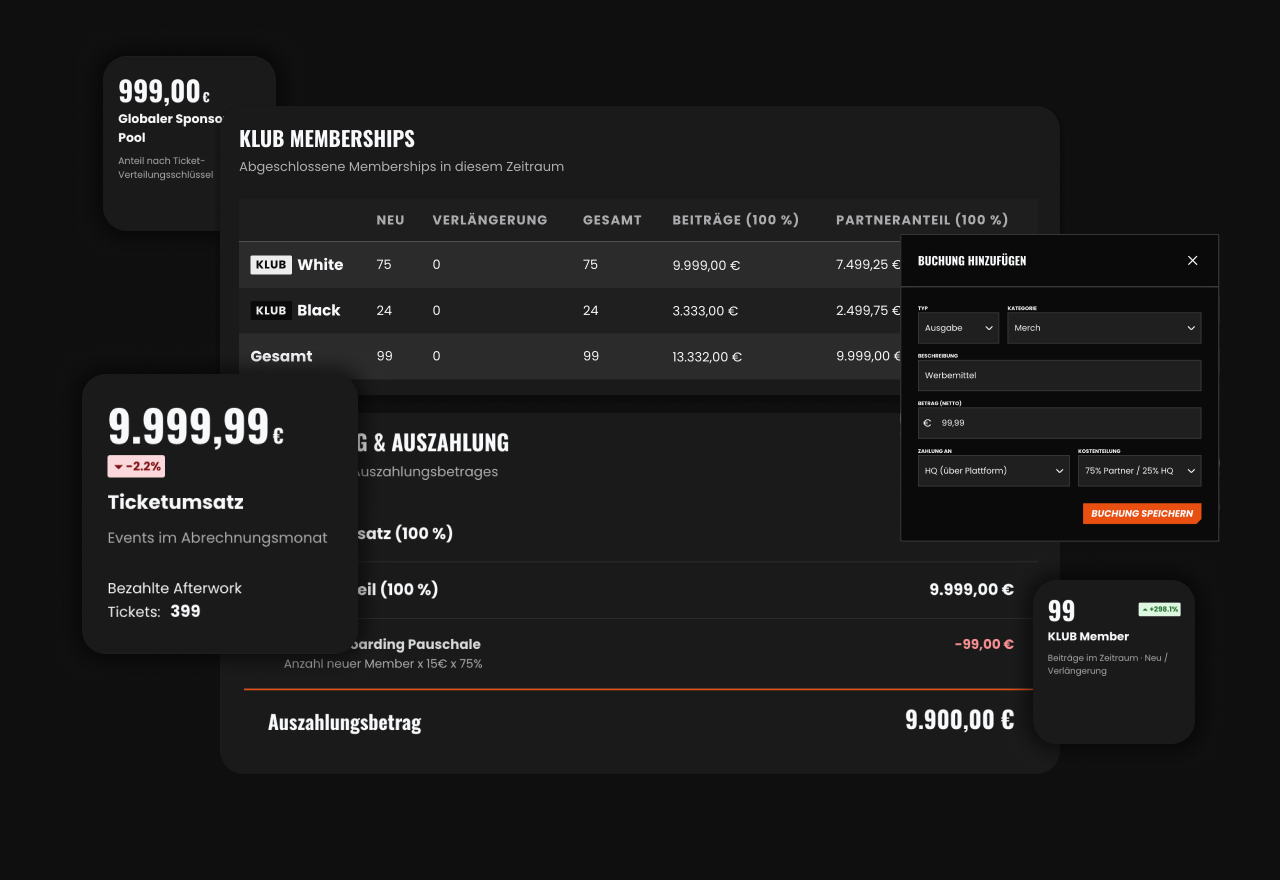
All data on ticket sales, memberships and sponsorships comes together summarized in one place. Billing gets much simpler, because no data has to be copied together from different sources and reports.
Newsletter tool
Instead of an external tool with separate accounts, every ÜBERSTUNDE partner structures and sends newsletters right in the dashboard. Headquarters can see which marketing activities ran and how they affected ticket sales.
Email automations
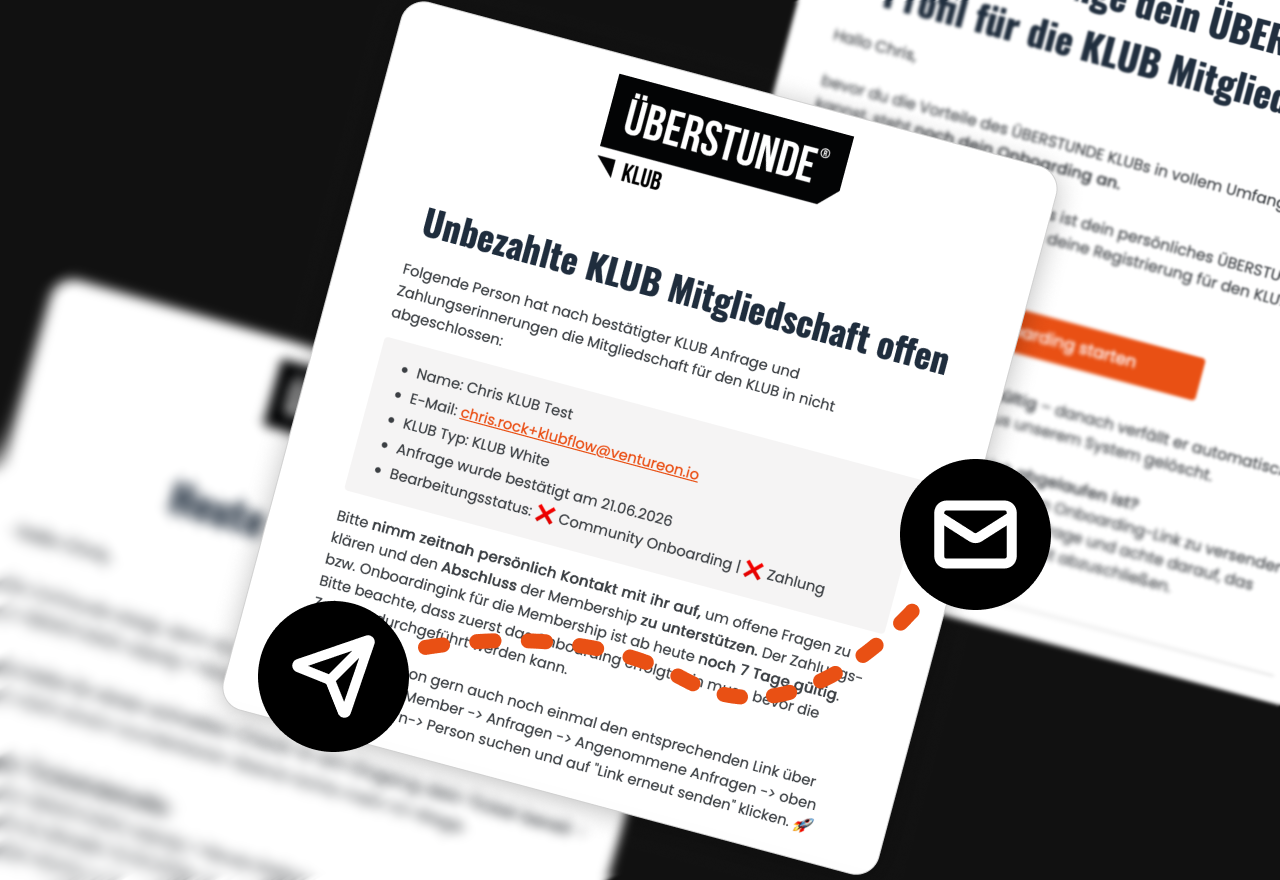
Optimised email marketing flows: reminder emails to the guest and/or the team when a ticket purchase or membership is still incomplete. On the day of the event, the ticket is sent again, so guests spend less time searching for it at check-in.
Countering planning uncertainty with design
ÜBERSTUNDE runs a large number of events every month, sometimes even every week. Under the previous concept, tickets could only go on sale once an event was fully planned and its details could be shared. In practice, that meant no income until roughly four weeks before the event.
This not only restricted the organiser financially, it also made it hard to plan capacity and staffing in advance.
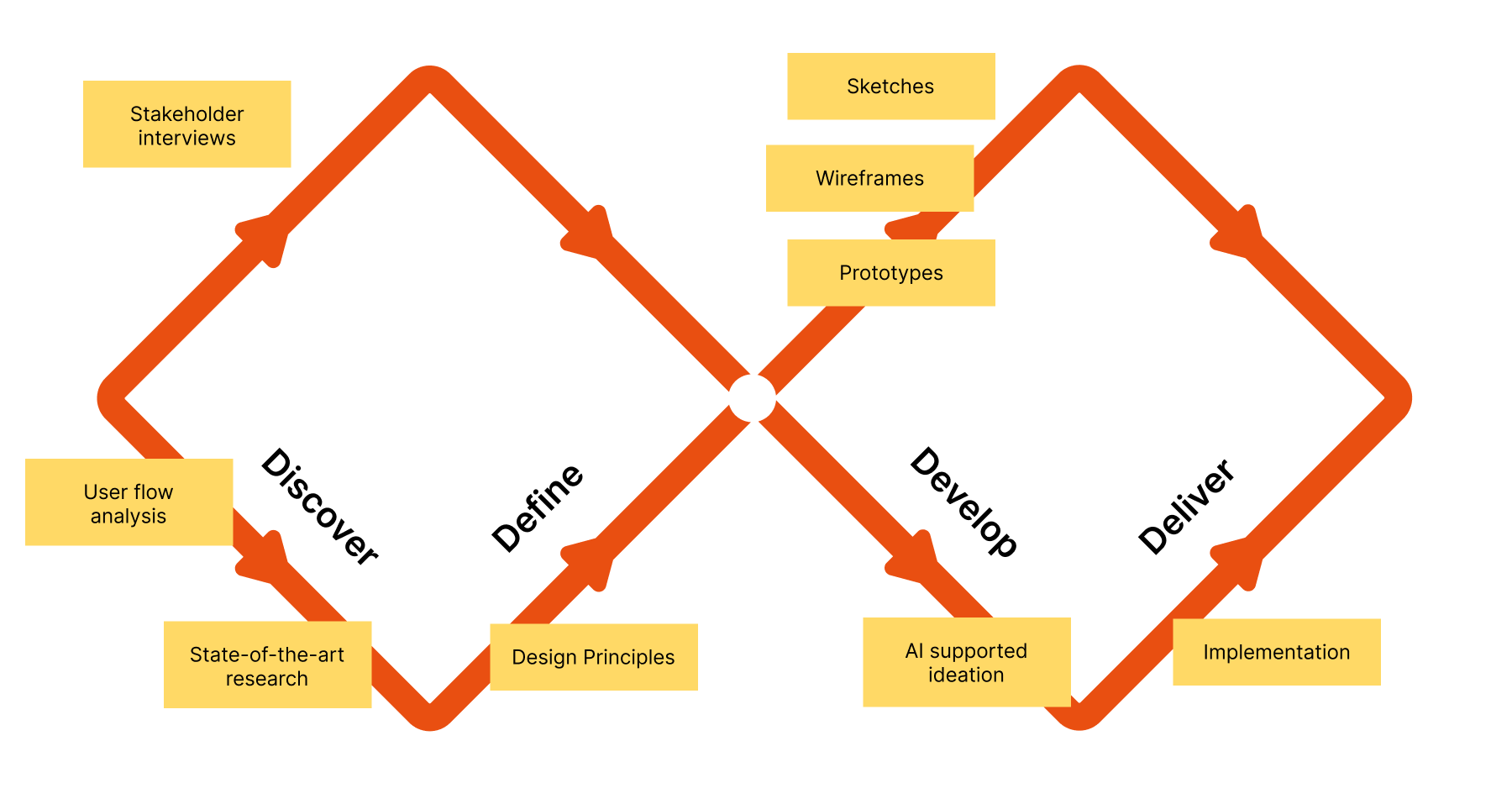
To tackle the problem, I followed the Double Diamond process, whose four phases also structure this deep dive.
Discover
I ran stakeholder interviews, analysed the existing user flows and did state-of-the-art research to understand the requirements: what the organiser can afford financially, the time frames of planning an event, and how costs are split across the different memberships.
The first step showed that some costs arise long before the actual income. The venue and partners such as catering, DJs and photographers often have to be paid in advance, while it stays unclear how well the event will sell.
Key finding: this is not a problem that a redesign of the interface alone can solve, because it is deeply tied to the sales and event management process. Under the previous process, an event could only be published, and ticket sales could only start, once all its details were in place and agreed with the event partners. As long as the process is structured this way, planning will always be uncertain, and the organiser will have to pay for the event up front without any income.
I learned this in conversations with one of the ÜBERSTUNDE managing directors, and the internal figures confirm it: half of all tickets were bought in the last nine days before the event.
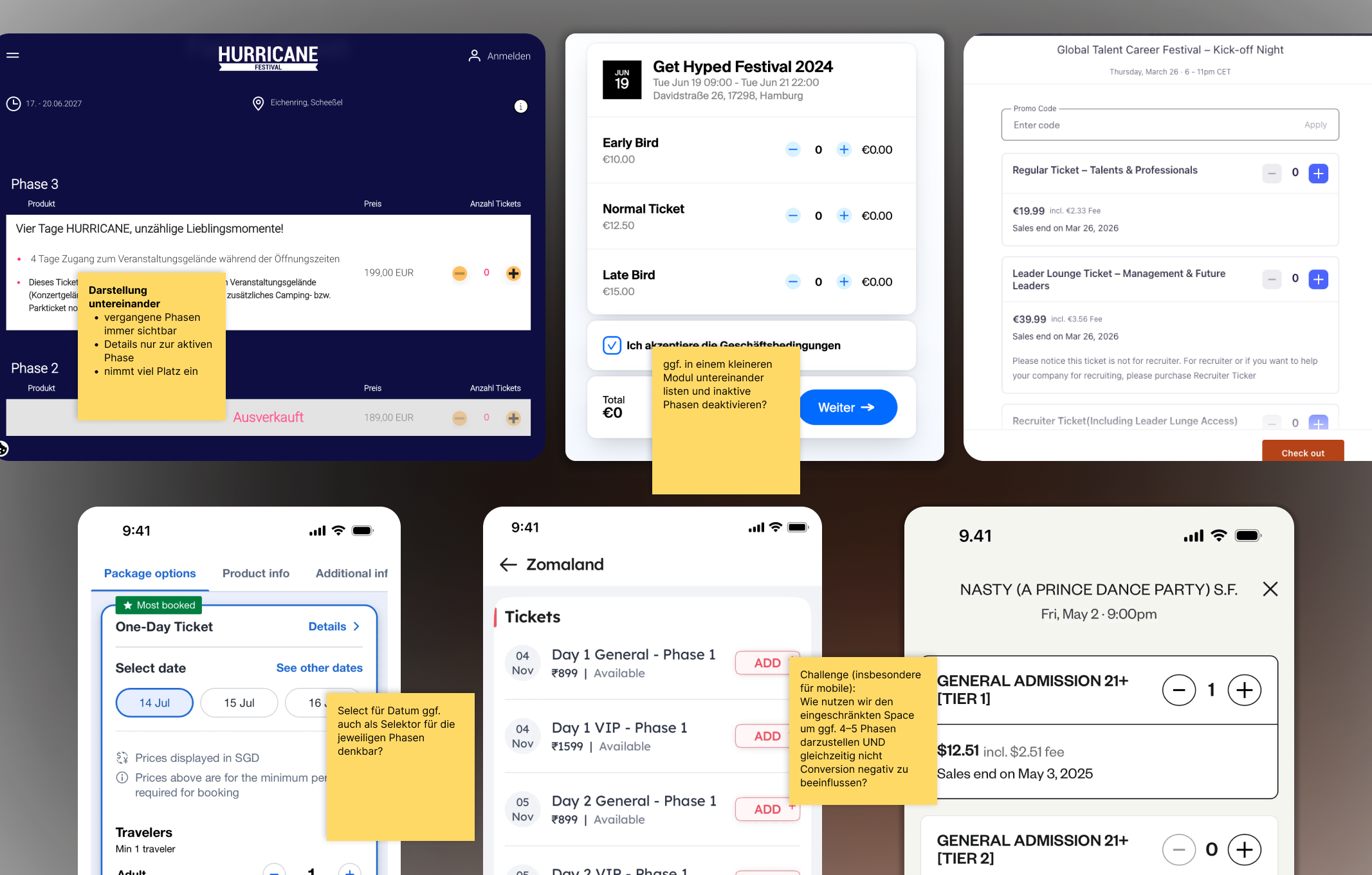
Looking at similar platforms in the industry showed that ticket phases are a common way to move ticket sales forward. Organisers accept a trade-off: they announce the event without details such as the line-up or the exact location, and lower the ticket price in return. As the event gets closer or more details are released, the next phase starts and the price goes up.
At first glance, this concept only partly fits ÜBERSTUNDE: there is usually no clear event agenda to reveal step by step, and depending on the type of membership, prices need to be discounted differently.
Define
From the findings of the Discover phase, I derived four how-might-we questions that set the frame for the more detailed work:
| Focus | How might we … |
|---|---|
| Awareness | … create awareness for upcoming events, even before they are fully planned? |
| Appeal | … make events attractive even before all their details are known? |
| Reward | … reward guests for committing early? |
| Clarity | … help guests understand the extra price information without getting in the way of buying a ticket? |
Together with the ÜBERSTUNDE team, we answered these questions with ticket phases and save-the-date events, meaning events published before all their details are revealed.
Assumptions
The idea rests on three assumptions:
-
Guests will buy a ticket before they know where the event takes place, as long as it is cheaper. Festivals already do this with blind tickets, sold before the line-up is announced.
-
Revenue from early sales takes pressure off the payments the organiser has to make in advance.
-
Early sales are a reliable enough signal to plan staff, catering and the size of the venue.
Requirements
Any solution had to meet these requirements from both sides:
Business
- Three prices have to be visible: for guests and the community, for KLUB White and for KLUB Black members.
- Events without ticket phases have to keep working, for example KLUB events that only members can attend.
- KLUB members pay the same price across all phases.
- The new checkout must not hurt conversion.
Guests
- The journey to buying a ticket changes as little as possible.
- Phases need no extra effort from guests and add no clicks on the way to a ticket.
- The checkout stays simple, because the ÜBERSTUNDE audience is very diverse.
Develop
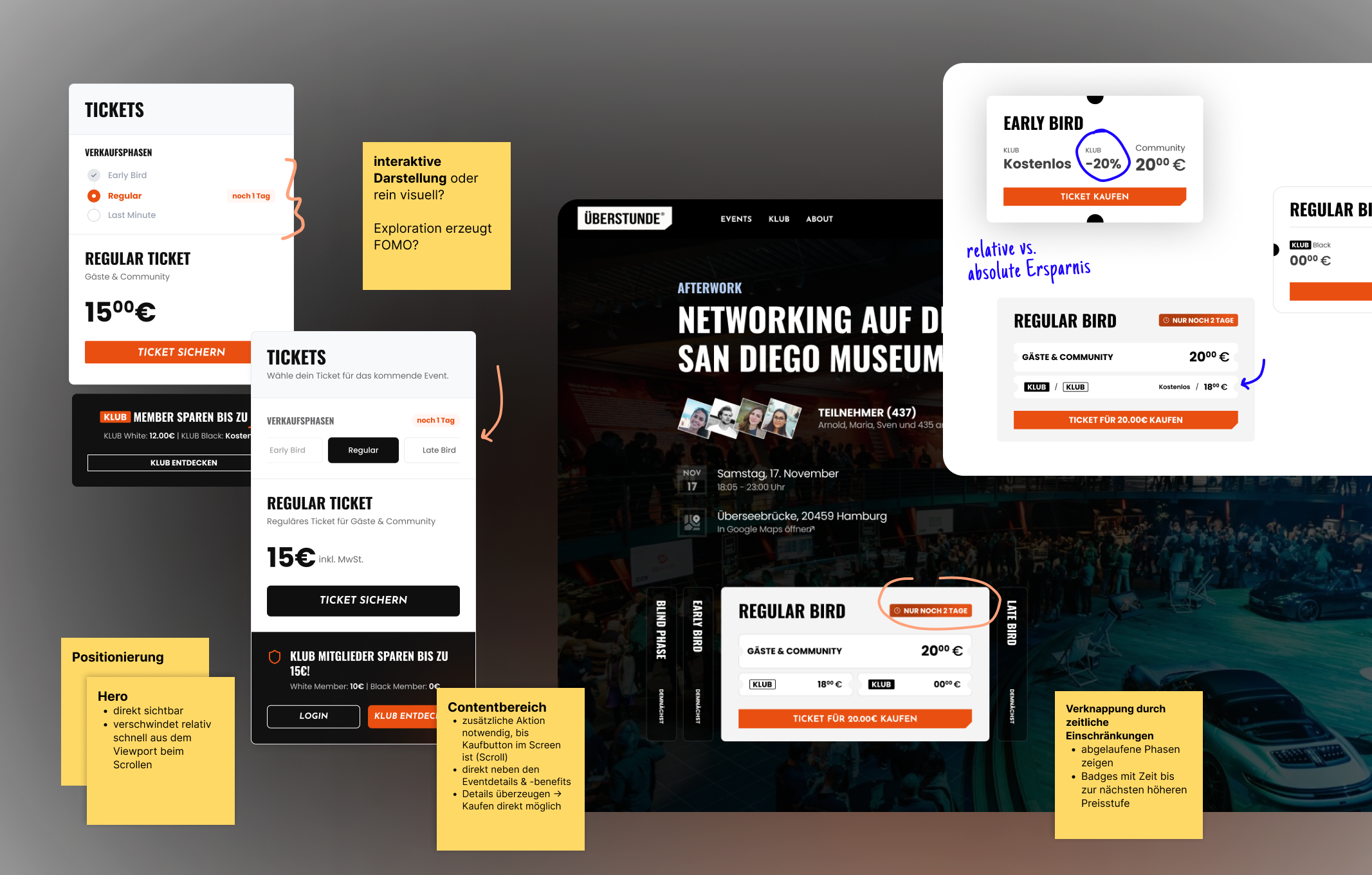
I worked with sketches, wireframes and prototypes, supported by AI-assisted ideation: I generated a wide range of first drafts with Figma Make and Claude Code. Small interactive prototypes of the variants helped to find the strongest ones, tested with the ÜBERSTUNDE team and with guests. I then merged the best elements of the AI drafts with my own designs and adapted them to the ÜBERSTUNDE corporate identity, which the AI struggled to get right.
- Human Brainpower




Deliver



I tested the favoured variants on the live site and discussed them with the stakeholders, then refined the final design by hand, combined the best elements of the variants, and implemented it.
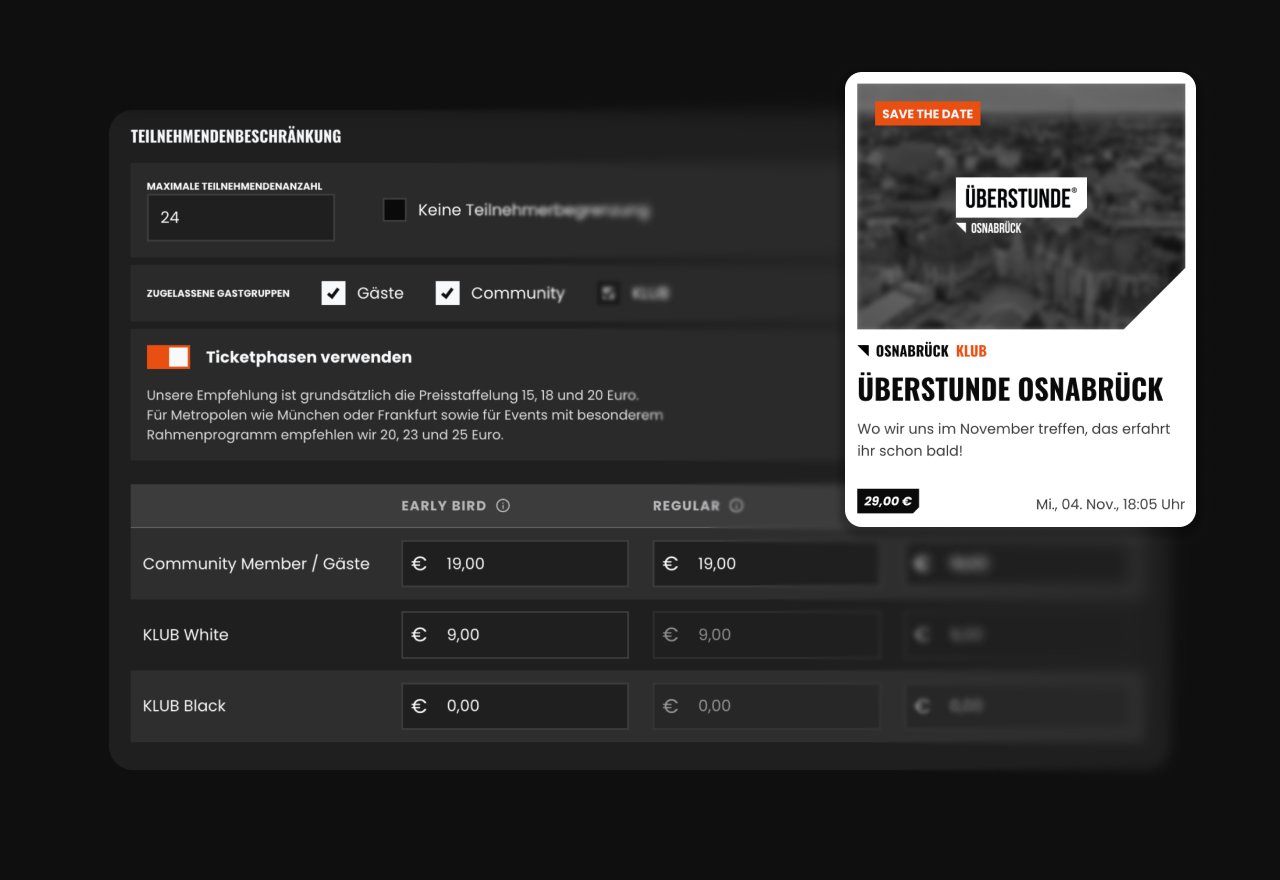
I built the ticket phases with Nordcraft for the website interface, Xano for the database and API, and Stripe for payments. For this, I extended the database with a phase table that the price table references. It sits directly on top of the existing database structure, without a complex migration.
When a ticket is bought, the correct price is fetched and passed to an externally hosted Stripe Checkout Session, where the purchase takes place.
I also extended the ÜBERSTUNDE dashboard with a way to manage ticket phases. Since the technical skills of ÜBERSTUNDE partners vary widely, phases are managed in a simple table, and a single switch turns them on or off for an event.
Exploration & scarcity
All phases stay visible in the ticket module, not only the current one. Guests can tap past and upcoming phases to explore them: they see what they have already missed on price, and how much more a ticket will cost later, which is a reason to buy now. A badge on the current phase shows how long it still runs, which adds scarcity.
Buying always in sight
The way to buy a ticket is always in view. In the hero, a call to action jumps straight to the ticket module. From there, the module scrolls along with the page while guests read the event details next to it. The details make the event appealing, and the purchase is never more than one click away.
The hero button sits exactly where the old buy button was, with the same look and label. Guests did not have to relearn anything.
Outcome
Results
To find out whether the ticket phases reach the intended goals and so confirm the assumptions, I compared the ticket sales of 76 events between January and October 2026: 28 events before the feature was released and 48 after. Because the ticket phases were added to events step by step, May is left out of both groups.
Tickets are bought earlier. The median lead time rose from 9.3 to 14.2 days, a shift of 4.9 days (95% confidence interval: 1.5 to 6.7 days). Two weeks before an event, half of all tickets are now sold, compared with 40% before. The share sold more than four weeks ahead rose from 4.0% to 10.4%, which was hardly possible before, as sales opened about four weeks ahead. The share sold in the last 48 hours fell only slightly, from 16.2% to 14.3%.
The new level has held for five months in a row, and both guests (8.9 to 13.3 days) and KLUB members (13.3 to 16.3 days) buy earlier. In conversations, guests described the discounted early prices as a clear positive, even though the price goes up in the later phases.
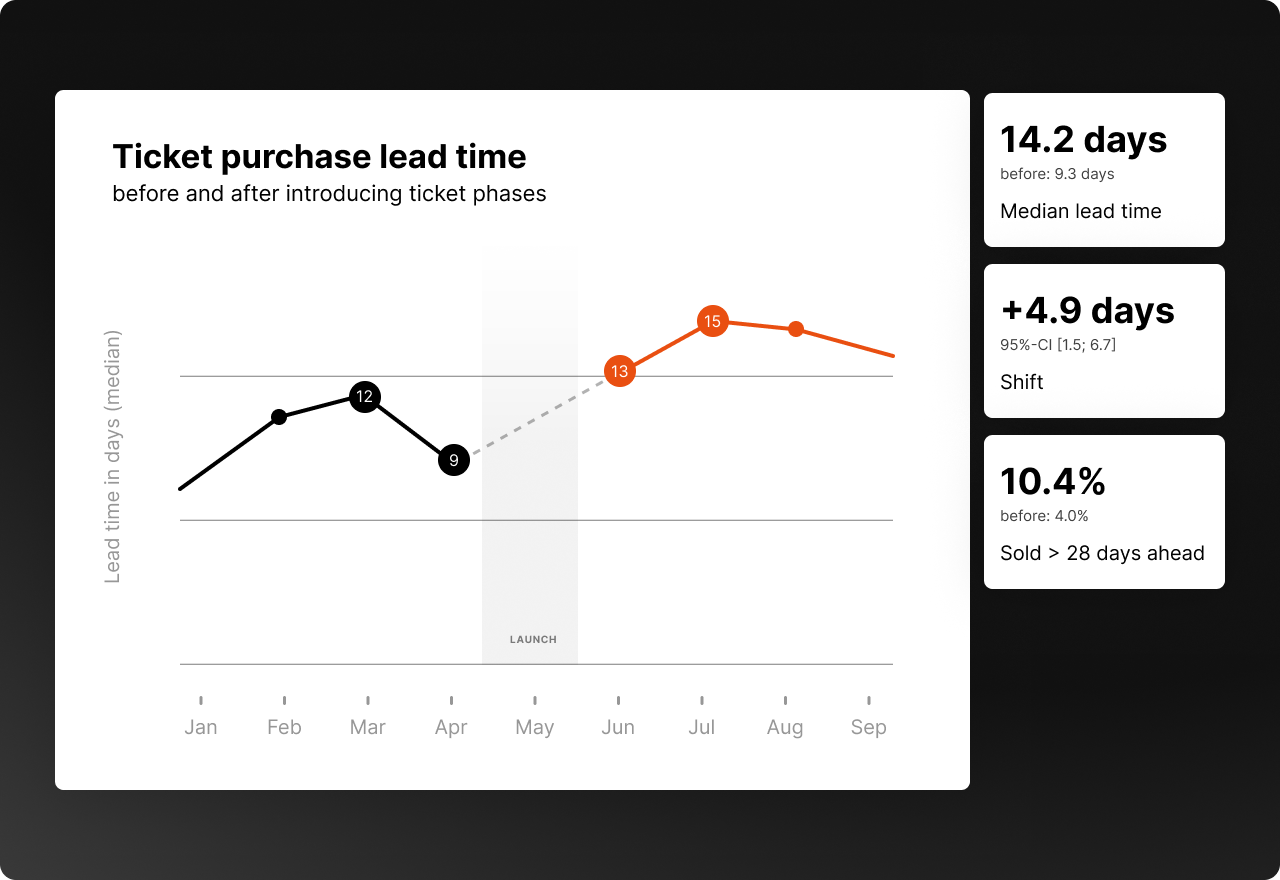
Two weeks before an event, 50.9% of tickets are now sold, instead of 40.4% before
The median ticket is now bought 14.2 days before the event instead of 9.3, so revenue comes in sooner
Save-the-date events go on sale up to 75 days ahead, instead of about four weeks before the event
Discussion
Looking back at the three assumptions from Define:
-
Guests buy before all details are known, if it is cheaper.Supported, with a limit. Guests buy earlier even within the period that was already open before: 21 to 28 days ahead, the share of tickets sold rose from 12.7% to 17.3%, and two weeks before an event half of all tickets are sold instead of 40%. But the audience seems to have its own planning horizon of about two weeks: opening sales even earlier, 40 to 75 days ahead instead of around 30, barely moved the median lead time.
-
Early sales take pressure off the payments made in advance.Partly supported. Revenue comes in earlier: four weeks before an event, 7.8% of tickets are now sold instead of 1.3%. That eases the payments made in advance, but it cannot cover costs that are due months ahead.
-
Early sales are a reliable signal for planning.Not confirmed. Events did not become more predictable. The lead times of individual events now vary more than before, partly because new cities joined during the period. What planning can rely on is the point two weeks before an event, when half of the tickets are sold, not four weeks.
The figures do not control for seasonality, the growing number of cities, a wider reach or changed reminder emails, so the effect cannot be attributed to the ticket phases alone. Still, the shift appeared exactly with the rollout and has stayed stable since. Beyond the numbers, the feature rewards regular guests without a membership: they attend events anyway and benefit most from the lower early prices.